




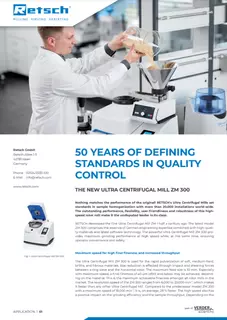
50 Years of Defining Standards in Quality Control: New Ultra Centrifugal Mill ZM 300
Nothing matches the performance of the original! RETSCH's Ultra Centrifugal Mills set standards in sample homogenization with more than 20,000 installations world-wide. The outstanding performance, flexibility, user-friendliness and robustness of this highspeed rotor mill make it the undisputed leader in its class.

A driving force in ingredient research
The discovery of new drugs (drug discovery) is a complex process that ranges from basic research to preclinical testing and clinical trials. In each of these phases, you benefit from precise and reproducible sample preparation, which has a significant impact on the success of your research. With Retsch’s customized solutions, you can specifically increase the efficiency and quality of your processes – from the initial sample to the market-ready formulation.
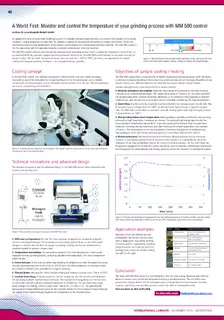
A World First: Monitor and control the temperature of your grinding process with MM 500 control
An apparently trivial yet potentially challenging point in a sample homogenisation process is to preserve the sample in its original condition. Sample preparation in ball mills, for example, is based on the physical mechanism of impact and friction. These two mechanisms result in heat development which poses a severe problem for temperature-sensitive materials. The MM 500 control is the first laboratory ball mill especially designed to process temperature- sensitive materials.

Accessories for Processing Small Volumes in Ball Mills
One of the challenges when using ball mills is the processing of small sample volumes. Food, tissues, pharmaceuticals, and many other samples are often limited to only a few grams in quantity. To homogenize such small amounts for analysis, or for developing new materials, matching jar volumes are required. In addition, small-volume jars allow for simultaneous processing of multiple samples. RETSCH offers an extended range of accessories for the processing of small sample volumes in mixer mills.

Air Jet Sieving - Particle Analysis without Sample Transfer
In particle analysis, the transfer between the sieving machine and the balance carries considerable potential for error due to erosion or adhesion. RETSCH has solved this problem with the completely redesigned AS 200 jet pro and pharma all-in-one air jet sieving machines.
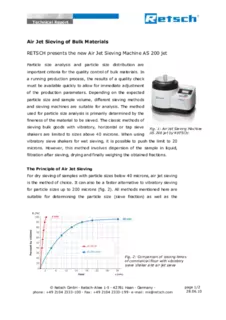
Air Jet Sieving of Bulk Materials
Particle size analysis and particle size distribution are important criteria for the quality control of bulk materials. In a running production process, the results of a quality check must be available quickly to allow for immediate adjustment of the production parameters. Depending on the expected particle size and sample volume, different sieving methods and sieving machines are suitable for analysis. The method used for particle size analysis is primarily determined by the fineness of the material to be sieved. For dry sieving of samples with particle sizes below 40 microns, air jet sieving is the method of choice.

Applications for battery technology
Read how RETSCH’s crushers, mills and sieve shakers are used for pulverization and size analysis of basic materials, components and recycling fractions.

Bulkinside - Retsch Cutting Mill SM 50 -The Easiest way to sample Preparation
Efficient and contamination-free sample preparation is crucial for the analysis of powders and bulk solids.Retsch's new tabletop cutting mill, the SM 50, available worldwide since April 1st, 2025, offers groundbreaking innovations that set new standards in precision and versatility while minimizing overall process time. Notably, the SM 50 stands out as the only solution on the market when dealing with scenarios where only a handful of sample material is available for the comminution task, making it an ideal choice for situations that demand exceptional adaptability.

Cell disruption of parasites with Bead Beating
Giardia and Cryptosporidia are parasites which occur in water and can cause diarrhoea in humans. They are persistent forms found in water and are resistant to environmental influences and disinfectants. Detection and quantitative determination of the parasites are typically performed in accordance with ISO 15553 „Water Quality – Isolation and Enumeration of Cryptosporidium oocysts and Giardia cysts from water“. A German microbiological laboratory has now tested a mechanical approach by using RETSCH’s Mixer Mill MM 400 for bead beating.

Chemical analyses for classification of artificial mineral wool
We often come across fibrous materials in everyday life. The fibers may be subdivided into natural ones like cellulose, hemp or asbestos and artificial ones like polyester or viscose [1] (figure 1). The artificial mineral fibers comprise crystalline fibers such as carbon fibers and silicon carbide but also amorphous fibers like glass wool or rock wool. Glass-like fibers are commonly used as insulating wool or as an additive in construction materials to enhance stability, toughness and durability.

Comparison RS200 & RS300
X-Ray fluorescence is one of the most versatile methods to determine element concentrations in a solid sample. The material is exposed to high-energy X-rays that cause each element to emit its own characteristic fluorescent X-ray. The analysis of the results is based on comparisons to standard samples with given chemical composition. Sample preparation has become an increasingly important issue because the detection limit of XRF analyzers has shifted to trace level in the past few years. Moreover, accurate analysis of major light elements is only possible with finely ground, homogeneous samples.

Contamination-free cutting of raw materials for the food and medical industries with the new SM 300 foodGrade
Raw materials for the food or pharma industry often require a size reduction process to minimize the particle size (tea, herbs, spices). The materials can be ready for consumption, like tea, or they are used for a second processing step, like extraction of valuable ingredients. A current example is CBD oil extraction from ground cannabis plants. For both – direct use or process step prior to extraction, the specific requirements of the food and medical industries must be considered when choosing a suitable size reduction tool. Aspects like smooth surfaces, easy cleaning, and available materials like stainless steel 316L to ensure contamination-free processing should be taken into account. Retsch has launched the new Cutting Mill SM 300 foodGrade for this type of applications and small-scale production of herbs and spices.

Cryogenic Disruption of Yeast Cells
At the Ernst Ruska-Centre-3 (ER-C-3) for Microscopy and Spectroscopy with Electrons, one of the institutes of the renowned Forschungszentrum Jülich, researchers harness the power of cryo-electron microscopy and cryo-electron tomography to answer important questions regarding the structure and function of biological membranes and membrane-associated protein complexes. To this end, various cellular systems, including yeast, are used as models to study the membrane systems of interest.

Cryogenic disruption of yeast cells according to the Rout Protocol
The Michael Rout Lab at the Rockefeller University in New York, NY, initially contacted RETSCH Inc. in 2006 to discuss the possibility of using the Planetary Ball Mill to cryogenically grind yeast cell pellets. The aim of their experiment was to explore the construct of Nuclear Pore Complexes located on the cell walls of yeast cells. The decision to use a Planetary Ball Mill for this application was mainly based on the fact that it produces very small particle sizes which were considered an important prerequisite for more in-depth analysis of the yeast cells.

Customized silicon particle sizes for li-ion batteries
Silicon is gaining increasing importance as an anode material for Li ion batteries. Its exceptionally high specific capacity of about 3,600 mAh/g allows it to store roughly ten times more lithium ions than conventional graphite. This potential makes silicon a key material for anodes or as an additive in carbon–silicon composite anodes. A crucial factor for the performance of Li ion batteries is the particle size of the silicon: it significantly influences the electrochemical behavior, cycle stability, and service life of the anode. For battery applications, silicon particles are therefore specifically adjusted to sizes ranging from a few micrometers down to the sub micrometer and nanometer scale.
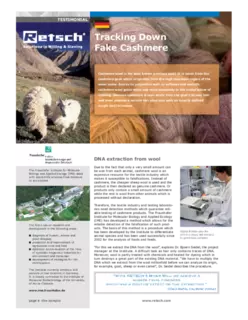
DNA extraction from wool - Fraunhofer IME
Due to the fact that only a very small amount can be won from each animal, cashmere wool is an expensive resource for the textile industry which makes it susceptible to falsifications. Instead of cashmere, the cheaper sheep wool is used and the product is then declared as genuine cashmere. Or products only contain a small amount of cashmere while the rest is wool from other animals which is processed without declaration. Therefore, the textile industry and testing laboratories need detection methods which guarantee reliable testing of cashmere products.

Endoprosthetics MM400
Prosthetic joint infections: New method allows for diagnostics of up to 8 samples with high documentation rate Joint replacements, especially of hip and knee joints, rank among the most frequent surgical interventions in industrialized countries. In Germany, specialists implant approximately 210,000 artificial hips and 165,000 artificial knees every year. Growing life expectancy as well as higher demands on the quality of life have led to a clear trend in endoprosthetics.
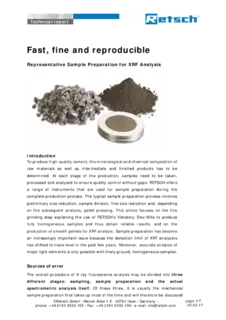
Fast, fine and reproducible - Sample Prep for XRF Analysis
The overall procedure of X-ray fluorescence analysis may be divided into three different stages: sampling, sample preparation and the actual spectrometric analysis itself. Of these three, it is usually the mechanical sample preparation that takes up most of the time and will therefore be discussed in this application report.
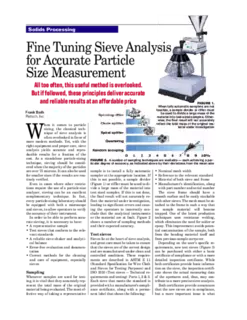
Fine Tuning Sieve Analysis for Accurate Particle Size Measurement
All to often, this useful method is overlooked. But if followed, these principles deliver accurate and reliable results at an affordable price.

Food samples - perfect homogenization with the knife mill GRINDOMIX GM 200
The diversity of foodstuffs with their often very different properties represents a challenge for food testing laboratories. Before the actual analysis, the sample materials need to be homogenized and reduced to a sufficiently small particle size. The Knife Mill GRINDOMIX GM 200 sets standards in food sample preparation: The cutting effect produced by the steel blades results in the perfect homogenization of samples with high water, oil, sugar or fat content.