




50 Years of Defining Standards in Quality Control: New Ultra Centrifugal Mill ZM 300
Nothing matches the performance of the original! RETSCH's Ultra Centrifugal Mills set standards in sample homogenization with more than 20,000 installations world-wide. The outstanding performance, flexibility, user-friendliness and robustness of this highspeed rotor mill make it the undisputed leader in its class.
A driving force in ingredient research
The discovery of new drugs (drug discovery) is a complex process that ranges from basic research to preclinical testing and clinical trials. In each of these phases, you benefit from precise and reproducible sample preparation, which has a significant impact on the success of your research. With Retsch’s customized solutions, you can specifically increase the efficiency and quality of your processes – from the initial sample to the market-ready formulation.
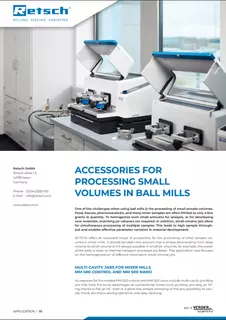
Accessories for Processing Small Volumes in Ball Mills
One of the challenges when using ball mills is the processing of small sample volumes. Food, tissues, pharmaceuticals, and many other samples are often limited to only a few grams in quantity. To homogenize such small amounts for analysis, or for developing new materials, matching jar volumes are required. In addition, small-volume jars allow for simultaneous processing of multiple samples. RETSCH offers an extended range of accessories for the processing of small sample volumes in mixer mills.
Air Jet Sieving of Bulk Materials
Particle size analysis and particle size distribution are important criteria for the quality control of bulk materials. In a running production process, the results of a quality check must be available quickly to allow for immediate adjustment of the production parameters. Depending on the expected particle size and sample volume, different sieving methods and sieving machines are suitable for analysis. The method used for particle size analysis is primarily determined by the fineness of the material to be sieved. For dry sieving of samples with particle sizes below 40 microns, air jet sieving is the method of choice.
Applications for battery technology
Read how RETSCH’s crushers, mills and sieve shakers are used for pulverization and size analysis of basic materials, components and recycling fractions.
Cryogenic disruption of yeast cells according to the Rout Protocol
The Michael Rout Lab at the Rockefeller University in New York, NY, initially contacted RETSCH Inc. in 2006 to discuss the possibility of using the Planetary Ball Mill to cryogenically grind yeast cell pellets. The aim of their experiment was to explore the construct of Nuclear Pore Complexes located on the cell walls of yeast cells. The decision to use a Planetary Ball Mill for this application was mainly based on the fact that it produces very small particle sizes which were considered an important prerequisite for more in-depth analysis of the yeast cells.
DNA extraction from wool - Fraunhofer IME
Due to the fact that only a very small amount can be won from each animal, cashmere wool is an expensive resource for the textile industry which makes it susceptible to falsifications. Instead of cashmere, the cheaper sheep wool is used and the product is then declared as genuine cashmere. Or products only contain a small amount of cashmere while the rest is wool from other animals which is processed without declaration. Therefore, the textile industry and testing laboratories need detection methods which guarantee reliable testing of cashmere products.
Fine Tuning Sieve Analysis for Accurate Particle Size Measurement
All to often, this useful method is overlooked. But if followed, these principles deliver accurate and reliable results at an affordable price.
Food samples - perfect homogenization with the knife mill GRINDOMIX GM 200
The diversity of foodstuffs with their often very different properties represents a challenge for food testing laboratories. Before the actual analysis, the sample materials need to be homogenized and reduced to a sufficiently small particle size. The Knife Mill GRINDOMIX GM 200 sets standards in food sample preparation: The cutting effect produced by the steel blades results in the perfect homogenization of samples with high water, oil, sugar or fat content.
From Graphite Powder to Graphite Power
Graphite plays a vital role as an electrode material in batteries, fuel cells, capacitors, and numerous industrial applications such as lubricants, conductive coatings, and composites. In battery technology, graphite particle size is a key determinant of battery capacity, cycle life, rate capability, and overall performance. Optimizing particle size and distribution is therefore critical for battery design and manufacturing. This joint report combines the expertise of Retsch, Microtrac, and Sugino to provide a comprehensive overview of graphite grinding, dispersion, and particle size analysis - supporting a deeper understanding of the entire process chain from milling and dispersion to analytical evaluation.
Green Cement - How Ball Milling Activates Clay for A Sustainable Future
The construction industry is rapidly evolving to meet the demands of sustainability, and green cement is at the forefront of this transformation. Traditional cement production is one of the largest sources of CO₂ emissions, mainly due to the energyintensive process of heating limestone and burning fossil fuels. Green cement tackles this issue by incorporating Supplementary Cementitious Materials (SCMs), such as activated clays, fly ash, and slag, which replace part of the conventional clinker - the primary source of emissions in cement. Activated clays are especially promising: they are abundant, locally available, and, when properly processed, can significantly reduce the carbon footprint of cement production.
Grinding samples with volatile components - Cottbus University, Germany
For the size reduction of many materials it is more suitable to use a cryogenic mill than a laboratory mill which operates at room temperature. The sample is embrittled by liquid nitrogen which improves its breaking behavior when submitted to impact, pressure and friction; moreover, volatile components of the sample are preserved.
How Cyclone Separators Redefine Efficiency and Cleanliness in the Lab
Cyclone separators deliver substantial benefits when used with mills in laboratory settings. While cutting mills or rotor mills are already frequently operated with a cyclone, also jaw crushers and disc mills benefit greatly from this setup. By using a cyclone, it is even possible to combine two mills directly: for example, a two-stage grinding process with a jaw crusher and a disc mill can be completed in a single step.
Innovative designs from recycled food waste
Food waste is a significant global issue that impacts the environment, economy, and society. Every year, millions of tons of food are wasted, contributing to greenhouse gas emissions, resource depletion, and economic losses. Food waste occurs at various stages of the supply chain, including production, processing, distribution, and consumption. The environmental impact of food waste is substantial, as it leads to the unnecessary use of water, energy, and land resources, while also generating methane emissions from decomposing organic matter in landfills.
Mechanical Alloying with High-Energy Ball Mills
The traditional way to produce alloys such as stainless steel is to fuse the components at very high temperatures. If only small quantities are required, or if melting cannot fuse the alloys, mechanical alloying is an alternative. One approach to this application is to use ball mills like the High-Energy Ball Mill Emax.
Mechanochemical Clay Activation
Orion ist ein weltweit führender Hersteller von Industrierußen (Carbon Black), die in zahlreichen Anwendungen eingesetzt werden. Ein bedeutendes Einsatzgebiet ist die Verwendung als Additiv in Lithium-Ionen-Batterien, um die elektrische Leitfähigkeit und Batterieleistung zu verbessern sowie die Lebensdauer zu verlängern. Um diese Anwendung im Detail untersuchen und Ruße gezielt für ihre Applikation optimieren zu können, hat Orion ein eigenes Batterielabor im Unternehmen aufgebaut.
Mechanochemistry: Working Toward a Sustainable Future
In the light of sustainability and Green Chemistry, mechanochemistry offers fast reactions in a solvent-free environment. Mass productivities often exceed the solvent-based reaction equivalents, and the work-up procedures are generally easier. Beside thermal, electrochemical and photochemical energy supply, a less known form of mechanochemistry is based on energy input by impact and shearing forces; typically ball mills are used to conduct those reactions. This article gives examples how mixer mills and planetary ball mills are successfully used to conduct mechanochemical processes.
Mixer Mill MM 400: Upgrade of a True Multipurpose Mill
With the Mixer Mill MM 400 RETSCH has developed a true multipurpose mill which covers a huge range of applications, including classic mixing and homogenization but also more complex tasks like cell disruption via bead beating or mechanochemical processes. The ease of use of mixer mills in general, combined with a wealth of accessories make the MM 400 the perfect choice for quick, safe and reproducible processing of small sample volumes.
New Cyclone Sets 2026
Cyclone sets are the ideal solution for clean, efficient, and material-friendly sample dis-charge in modern sample preparation processes. They ensure highly efficient separa-tion of sample material from the airflow, reliably replacing conventional gravity dis-charge outlets.
New Solutions for Cement and Concrete
The cement and concrete industry is one of the key pillars of the global construction sector. Without cement, there would be no stable buildings, roads, or bridges: it is the binding agent of modern infrastructure. Every year, billions of tons of cement are produced worldwide to meet the growing demand for housing, transportation networks, and industrial facilities. The industry is characterized by stringent quality requirements, complex chemical processes, and continuous development toward more sustainable and energy‑efficient material technologies.