



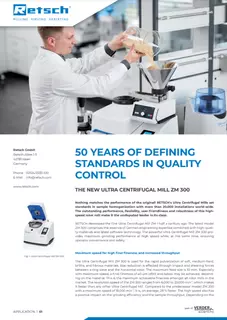
50 Years of Defining Standards in Quality Control: New Ultra Centrifugal Mill ZM 300
Nothing matches the performance of the original! RETSCH's Ultra Centrifugal Mills set standards in sample homogenization with more than 20,000 installations world-wide. The outstanding performance, flexibility, user-friendliness and robustness of this highspeed rotor mill make it the undisputed leader in its class.
A driving force in ingredient research
The discovery of new drugs (drug discovery) is a complex process that ranges from basic research to preclinical testing and clinical trials. In each of these phases, you benefit from precise and reproducible sample preparation, which has a significant impact on the success of your research. With Retsch’s customized solutions, you can specifically increase the efficiency and quality of your processes – from the initial sample to the market-ready formulation.

Accessories for Processing Small Volumes in Ball Mills
One of the challenges when using ball mills is the processing of small sample volumes. Food, tissues, pharmaceuticals, and many other samples are often limited to only a few grams in quantity. To homogenize such small amounts for analysis, or for developing new materials, matching jar volumes are required. In addition, small-volume jars allow for simultaneous processing of multiple samples. RETSCH offers an extended range of accessories for the processing of small sample volumes in mixer mills.
Air Jet Sieving of Bulk Materials
Particle size analysis and particle size distribution are important criteria for the quality control of bulk materials. In a running production process, the results of a quality check must be available quickly to allow for immediate adjustment of the production parameters. Depending on the expected particle size and sample volume, different sieving methods and sieving machines are suitable for analysis. The method used for particle size analysis is primarily determined by the fineness of the material to be sieved. For dry sieving of samples with particle sizes below 40 microns, air jet sieving is the method of choice.
Applications for battery technology
Read how RETSCH’s crushers, mills and sieve shakers are used for pulverization and size analysis of basic materials, components and recycling fractions.
Cell disruption of parasites with Bead Beating
Giardia and Cryptosporidia are parasites which occur in water and can cause diarrhoea in humans. They are persistent forms found in water and are resistant to environmental influences and disinfectants. Detection and quantitative determination of the parasites are typically performed in accordance with ISO 15553 „Water Quality – Isolation and Enumeration of Cryptosporidium oocysts and Giardia cysts from water“. A German microbiological laboratory has now tested a mechanical approach by using RETSCH’s Mixer Mill MM 400 for bead beating.
Chemical analyses for classification of artificial mineral wool
We often come across fibrous materials in everyday life. The fibers may be subdivided into natural ones like cellulose, hemp or asbestos and artificial ones like polyester or viscose [1] (figure 1). The artificial mineral fibers comprise crystalline fibers such as carbon fibers and silicon carbide but also amorphous fibers like glass wool or rock wool. Glass-like fibers are commonly used as insulating wool or as an additive in construction materials to enhance stability, toughness and durability.
Cryogenic disruption of yeast cells according to the Rout Protocol
The Michael Rout Lab at the Rockefeller University in New York, NY, initially contacted RETSCH Inc. in 2006 to discuss the possibility of using the Planetary Ball Mill to cryogenically grind yeast cell pellets. The aim of their experiment was to explore the construct of Nuclear Pore Complexes located on the cell walls of yeast cells. The decision to use a Planetary Ball Mill for this application was mainly based on the fact that it produces very small particle sizes which were considered an important prerequisite for more in-depth analysis of the yeast cells.
DNA extraction from wool - Fraunhofer IME
Due to the fact that only a very small amount can be won from each animal, cashmere wool is an expensive resource for the textile industry which makes it susceptible to falsifications. Instead of cashmere, the cheaper sheep wool is used and the product is then declared as genuine cashmere. Or products only contain a small amount of cashmere while the rest is wool from other animals which is processed without declaration. Therefore, the textile industry and testing laboratories need detection methods which guarantee reliable testing of cashmere products.
Fast, fine and reproducible - Sample Prep for XRF Analysis
The overall procedure of X-ray fluorescence analysis may be divided into three different stages: sampling, sample preparation and the actual spectrometric analysis itself. Of these three, it is usually the mechanical sample preparation that takes up most of the time and will therefore be discussed in this application report.
Fine Tuning Sieve Analysis for Accurate Particle Size Measurement
All to often, this useful method is overlooked. But if followed, these principles deliver accurate and reliable results at an affordable price.
Food samples - perfect homogenization with the knife mill GRINDOMIX GM 200
The diversity of foodstuffs with their often very different properties represents a challenge for food testing laboratories. Before the actual analysis, the sample materials need to be homogenized and reduced to a sufficiently small particle size. The Knife Mill GRINDOMIX GM 200 sets standards in food sample preparation: The cutting effect produced by the steel blades results in the perfect homogenization of samples with high water, oil, sugar or fat content.
Food samples - safe and efficient cryogenic grinding
Most sample materials can be ground to the required analytical fineness at room temperature. However, there are limits, for example when even a small temperature increase affects the sample in a negative way; or when the material is very elastic and will only be deformed. Moreover, food samples which are fatty or sticky may block the mill. Therefore, cryogenic grinding is the best way to pulverize food samples like cheese, raisins, wine gum or marzipan which simply clump together when ground at room temperature.
From Graphite Powder to Graphite Power
Graphite plays a vital role as an electrode material in batteries, fuel cells, capacitors, and numerous industrial applications such as lubricants, conductive coatings, and composites. In battery technology, graphite particle size is a key determinant of battery capacity, cycle life, rate capability, and overall performance. Optimizing particle size and distribution is therefore critical for battery design and manufacturing. This joint report combines the expertise of Retsch, Microtrac, and Sugino to provide a comprehensive overview of graphite grinding, dispersion, and particle size analysis - supporting a deeper understanding of the entire process chain from milling and dispersion to analytical evaluation.
Genetically modified organisms (GMO) - detection in food and feed samples
Genetic engineering opens up new possibilities in areas such as medical research, development of alternative fuels or global food supply. It is used to modify the characteristics of plants in order to increase the crop yield, improve defense against predators, pesticides or draught, but also increase concentrations of essential vitamins. However, with regards to food the use of genetic engineering is a fairly controversial issue.
Green Cement - How Ball Milling Activates Clay for A Sustainable Future
The construction industry is rapidly evolving to meet the demands of sustainability, and green cement is at the forefront of this transformation. Traditional cement production is one of the largest sources of CO₂ emissions, mainly due to the energyintensive process of heating limestone and burning fossil fuels. Green cement tackles this issue by incorporating Supplementary Cementitious Materials (SCMs), such as activated clays, fly ash, and slag, which replace part of the conventional clinker - the primary source of emissions in cement. Activated clays are especially promising: they are abundant, locally available, and, when properly processed, can significantly reduce the carbon footprint of cement production.
Grinding samples with volatile components - Cottbus University, Germany
For the size reduction of many materials it is more suitable to use a cryogenic mill than a laboratory mill which operates at room temperature. The sample is embrittled by liquid nitrogen which improves its breaking behavior when submitted to impact, pressure and friction; moreover, volatile components of the sample are preserved.
Grinding tools - their effect on metal contamination
Reliable and accurate analysis results can only be guaranteed by reproducible sample preparation. This consists of transforming a laboratory sample into a representative part sample with homogeneous analytical fineness. Retsch offers a comprehensive range of the most modern mills and crushers for coarse, fine and ultra-fine size reduction of almost any material. The selection of the correct grinding tool depends on the sample material and the subsequent method of analysis.
Homogenization of tough biological secretions or tissue pieces
Sometimes the preparation and homogenization of biological samples can be as tough as the material itself. The widely used 2 ml single-use Eppendorf tubes are often not large enough to accommodate the whole sample volume; hence, the sample needs to be divided and reunited after the homogenization process which means an additional time-consuming working step in the lab routine. While it is true that usually larger sized grinding jars, e. g. of stainless steel, are available which accommodate the complete sample volume, these have the drawback of requiring cleaning after use.
How Cyclone Separators Redefine Efficiency and Cleanliness in the Lab
Cyclone separators deliver substantial benefits when used with mills in laboratory settings. While cutting mills or rotor mills are already frequently operated with a cyclone, also jaw crushers and disc mills benefit greatly from this setup. By using a cyclone, it is even possible to combine two mills directly: for example, a two-stage grinding process with a jaw crusher and a disc mill can be completed in a single step.